Content to share with you
Videos, Blogs, and Podcasts

What do you mean when you say Open Source?
Blog Post
InnerSource and Corporate Culture
InnerSource Commons Summit 11/2021
Panel: The Growth of InnerSource in Financial Services
Open Source Strategy Forum, London 10/2021
Barriers to Open Source Success in Financial Services
Open Source Strategy Forum, London 10/2021
Talent and OS Ecosystems with Gil Yehuda
OSPOlogy Webcast 9/2021
Why have an OPSO? with Nithya Ruff and Gil Yehuda
Open Source in Business Webcast 4/2021
Panel: Open Source for Risk Averse organizations
GitHub Universe 2019

InnerSource Patterns - Gil Yehuda / Fei Wan / Sebastian Spier
ISC Community Call 10/2021

InnerSource and Organizational Culture
1 of 3
Blog Post

InnerSource and Organizational Behaviors
2 of 3
Blog Post

InnerSource and Organizational Bureaucracy
3 of 3
Blog Post


Publishing COVID-19 Open Data
Sustain Open Source Podcast

The Business of Open Source
Open Source for Business Podcast

The Open Source Initiative
Dash Open Podcast

Contributor License Agreements
Dash Open Podcast
Mentoring and Community
Dash Open Podcast
Running an Open Source Program
Dash Open Podcast

Challenge Norms to Bring Your Best
1 of 4
Open Source Reflections Blog

Open Source Layers and Numbers
2 of 4
Open Source Reflections Blog

Being Open to Invite Success
3 of 4
Open Source Reflections Blog

Collaboration, Courage, Modesty
4 of 4
Open Source Reflections Blog
Securing Open Source w/ GitHub Alerts
A talk at the Linux Foundation Open Source Summit 2019
Screwdriver: CI/CD and Testing at Scale
A case study with SauceLabs
Creating a Unified Open Source Program
A talk at OSCON 2019
Working transparently
The Workstyle Movement by Jive
Reflections on the Open Source workshop at NASA
Superpowers
I'm an open source professional. I love to collaborate, lead, and inspire people to work together. My roles connect to my passion for open collaboration in a technical setting to achieve amazing results.

Corporate Open Source
Open Source Program Office (OSPO)
OSPOs manage open source policies and processes to help companies and engineers achieve success. I have created and managed multiple OPSOs, performed open source audits, established tooling, published hundreds of projects, and reviewed dozens of open source deals.

Developer Services
Providing services to internal engineers
I've led engineering standards groups, tech training, intranet collaboration, and tech documentation services. My team managed developer events (conferences, meetups, and hack days). I also managed corporate tech blogs and podcasts.

Open Source, Openly
Member of TODOGroup, Open Source Directors
The TODOGroup is a group of Open Source professionals committed to improving corporate open source programs. We publish guides, deliver talks, address issues, and coordinate with open source foundations to help improve the industry.

Doing Good
President of Yahoo Employee Foundation (YEF)
I was president of YEF where I leverages the talent, time, and financial resources of Yahoo employees to serve communities around the globe. Over 19 years, we issued more than $44M to 800 worthy causes. As president, I led the board and guided our social responsibility efforts.

Helping Others
Yahoo's Tech for Good Initiative
I led initiatives that ensured Yahoo's technology was used for good. For example, we improved the security features for a suicide prevention website. We open sources COVID data tools. I represented Yahoo at the White House's Champions of Change event.

Public Speaking
Guest Lecturer, Keynote Speaker, Top Writer
I have lectured at Columbia University, New York University, and Hunter College. I delivered the keynote address at the Linux Foundation Japan conference and the Verizon Media Tech Pulse. I have published open source guides and research papers.
Work Experience & Education

My resume
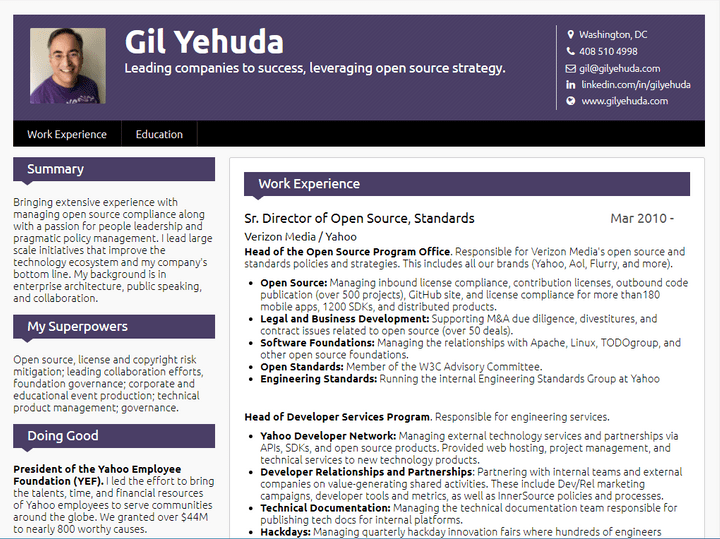
Click on the image to get to the content and download the PDF
Find out more